
Backlit LED Lightbox Demo Using WS2811 Digital LED Modules – From CNC to 2D Pixel Mapping
For presentation purposes, we built a demo lightbox to showcase the capabilities of addressable (pixel) lighting in a classic signage form factor. The goal was to demonstrate how much control and visual quality you can achieve using 2D pixel mapping—especially for non-standard shapes.
In this project we used 67 digital LED modules (RGB, 12 V, WS2811, IP68 class) and our Elegant S80 controller with customized firmware.
CNC Manufacturing and Mechanical Assembly
We started by preparing the lightbox components on a CNC router:
-
cutting the letter body and internal partitions,
-
defining the internal depth and mounting space to ensure uniform light distribution,
-
bonding the components into the final rigid structure.
This lightbox is designed strictly as an indoor demo unit, so it was built for quick access and easy presentation. The letter can be opened using magnets, allowing customers to see the internal layout and wiring.
Installing WS2811 Digital LED Modules (RGB 12 V)
The lightbox is illuminated using WS2811 digital LED modules:
-
RGB, 12 V, WS2811 (addressable)
-
1 addressable “pixel” = 1 module
-
each module contains 3 LEDs, but they are controlled together as one pixel
This is important from an effects perspective: the animation resolution is determined by the number of modules, not the number of individual LEDs. In our case the lightbox uses 67 mapped pixels.
The modules were positioned to provide even coverage under the semi-transparent front (diffuser). The enclosure and the front layer both help spread the light so the output looks smooth rather than “spotty”.
Wiring Topology and Signal Chain
All modules operate in a single WS2811 data chain, connected IN → OUT according to signal direction.
Power and cable management were organized at the base so that:
- the internal layout remains clean and readable during presentations,
- the lightbox can be easily powered and demonstrated.
For mobility, the demo is currently driven from a battery power source, making it convenient to show to customers without relying on mains power.
Building a 2D Pixel Map
A critical step was creating a 2D pixel map. In irregular shapes, the physical geometry of the letter usually does not match the electrical order of the WS2811 chain. Therefore:
- we captured a reference image of the internal layout,
- we marked module positions in a pixel-mapping tool (e.g., “Image Point Picker”),
- we exported the map into the format used by the controller firmware,
- we uploaded the configuration to the customized Elegant S80.
This ensures effects are calculated based on real X/Y coordinates, not just the raw pixel index order.

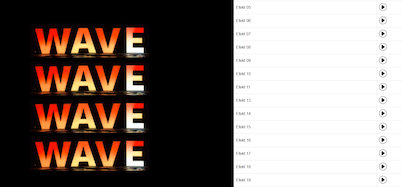
Effect Generation and Projection onto Mapped Pixels
Effects are generated as a 2D virtual scene and then projected onto the physical modules using the pixel map:
-
an algorithm renders an animation in 2D space (wave/gradient/transitions),
-
for each mapped point, a color is sampled from the virtual scene,
-
the resulting colors are sent through the WS2811 chain in the required pixel order.
This approach makes the animation look “native” to the letter shape rather than a simple 1D chase effect.
Effect approval before delivery
Before finalizing the controller configuration, we send the customer an MP4 video presenting the requested effect (a visualization). This allows the customer to confirm that:
- animation direction and speed match the expectations,
- colors, contrast, and overall dynamics look correct on the target geometry,
- looping and transitions are smooth and free of visible artifacts.
Based on the video approval, we apply any necessary adjustments so the final effect matches the project requirements.
An example visualization (MP4) can be attached to this project entry.
Gamma correction (optional)
If requested, we can apply color gamma correction to better match the output to the diffuser material, brightness level, and the desired perception of color transitions (e.g., smoother low-level dimming and more consistent gradients).
Summary
This demo lightbox was created to demonstrate the full workflow:
-
CNC fabrication and assembly,
-
installation of 67 WS2811 RGB 12 V modules,
-
clean single-chain wiring,
-
2D pixel mapping,
-
generating and projecting effects onto the real geometry.
The same method can be applied to production signage and architectural lighting where precise control and custom animations are required.